Showing posts with label Path to Purchase. Show all posts

Thursday, 6 September 2012

M&S And Paths to Purchase

Although M&S sells about one in three dresses and one in five of its suits online, school-wear has become one of the company’s most popular smartphone products with families looking to avoid the stressful “back to school” shopping trip.

Question is..was this smartphone helping with a customer pain point by design or just a lucky coincidence?


Understanding the salescycle or as we often refer to it these days Path to Purchase is key to understanding how we can help customers overcome those barriers to purchase.


There are many ways of depicting these journeys or paths, here is one I have come across. Figure 1 taken from an ATG webinar shows the path from Search to Purchase


path to purchase visual resized 600
Figure 1 Search to Purchase

This search to purchase journey depicts a customer journey that involves both the digital aspects of searching and researching a product as well as purchasing . Of course, in reality there is often, as depicted here, a physical element where customers want to view , touch and perhaps get more information by visiting the physical store before buying on-line. I've previously talked about combating this 'showrooming' by possibly encouraging in store purchase with an amazing experience or encouraging on going engagement once out of the store. ( See 'Combating Showrooming ,  Personalisation In-store )

M&S is trying to achieve both of these with some key projects.

Their stores are getting wi-fi that will be free for customers possibly as a way of allowing them to find out more about products as well purchasing from their wider range on line. to aid this QR codes are being used in-store

Figure 2 M&S App Screenshot
And of course their App will aid in this ( see Figure 2)

Also, some store assistants ill be getting iPads to help customers in the same way.
Figure 3 - Contactless Payment


Not forgeting the quick, small purchase ( the M&S .....), they are also adopting faster ways to pay with contactless options - Figure 3


You may have even seen the oversized smartphones in their stores

The one in figure 4 is actually in their store in Paris where customers are again able to purchase from the extended range on line - or even buy while on day trip to Paris and get it delivered back in the UK?
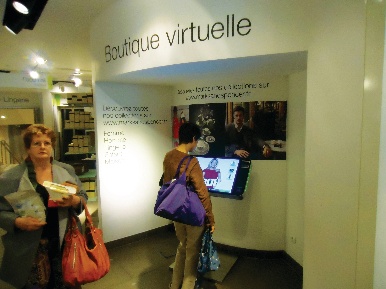
Marks and Spencer pushes its social network presence in its windows and shoppers can order products at the ‘boutique virtuelle’
Figure 4 - Oversized Smartphones in Paris


And of course they are addressing the delivery element by allowing customers to have items delivered to their home or most convenient store. This option incorporating that crucial free delivery tag so many consumers want ( see Amazon Set to Deliver Via Newsagents )


Sources
Marks and Spencer data sourced from their 2012 Corporate Report

Friday, 22 June 2012

Lifecycle Marketing - It's All about Customer Needs and Wants

Individuals might look the same but that doesn't mean they will act in the same way or indeed need the same things.

The combination of choices of good and services available to a customer and the wealth of communication channels available to a brand make it a complicated world. This is the challenging environment a brand faces when it is trying to get a message through to a prospect or indeed an existing customer.

But by cracking this nut and treating customers at an individual level can pay massive dividends when trying to measure ROI. At the end of the day that's what it is all about, numbers

But ROI can't be built around a neat little profile of what customer segment ' Jason and Trudy' look like. ROI can only be built around what Jason and Trudy actually do, or what we can get them to do.

And ultimately, we can only get Jason and Trudy to do something if we interact with them in a way they control and are comfortable with AND that costs in for us.

If they want us to talk to them about baked beans via expensive pieces of direct mail, it just wont happen. Conversely, if a prestige car brand thinks it can sell premier quality cars via email only they are going down a one way street, the wrong way!

As shown as far back as the 2009 Forrester Research survey, “Profiling the Multichannel Consumer,” 70% of U.S. consumers that research online and purchase offline, 85% are multichannel buyers. Many organisations estimate that as much as 50% of their customers — typically those of highest value — purchase across multiple channels


In reality, a multi channel approach has been shown to work best, as long as we are mindful of the following

1- the messages coming through those channels look like they are coming from the same organisation. And by look I mean that they look, feel, sound and taste the same.

2 - each of the channels is used to it's strengths and and on what the customer or potential customer wants to use it for. Part of that involves understanding the lifecycle at a macro level , often depicted as in Figure 1


Figure 1

And the understanding what customers want or need at those various stages. As in any journey, the things you need will differ depending where you are on that journey, and there are other things you  don't want. The brands role is to match these needs and wants with content that is relevant and hence results in engagement - Figure 2.  


Figure 2


What's the best way of finding out what customers want ?. Ask them and Test your approach because ultimately it' about what customers do rather than what they say will do.

Actions based on a combination of what customers say and do will ultimately smooth their path to purchase