Showing posts with label ecrm. Show all posts

Thursday, 22 November 2012

Russell and Bromley's Missed Opportunity

As a Russell and Bromley fan , I was interested to see if their shoes could be purchased online.

It seemed that I caught them mid-upgrade

But it was great to see that they offered me the opportunity to keep in touch and find out when the new website was up and running sometime in the Autumn. ( Having worked with a few Marketing  Teams, they love to be that vague with the launch dates - not that the customers like it)


So the email sign up looked like this, and it was great to see that they didn't ask too much of me


And a matter of moments later I got a welcome email.

But that was the beginning of October 2012, and not having had any emails since I thought I'd take a peek at their website today...and can you spot the subtle change in copy?


Looks like a slight slip in the delivery date.

Now of course they still have bricks and mortar stores so surely there was an opportunity a month into the 'relationship' to keep me in touch as to what was happening both on and off line?

Monday, 30 July 2012

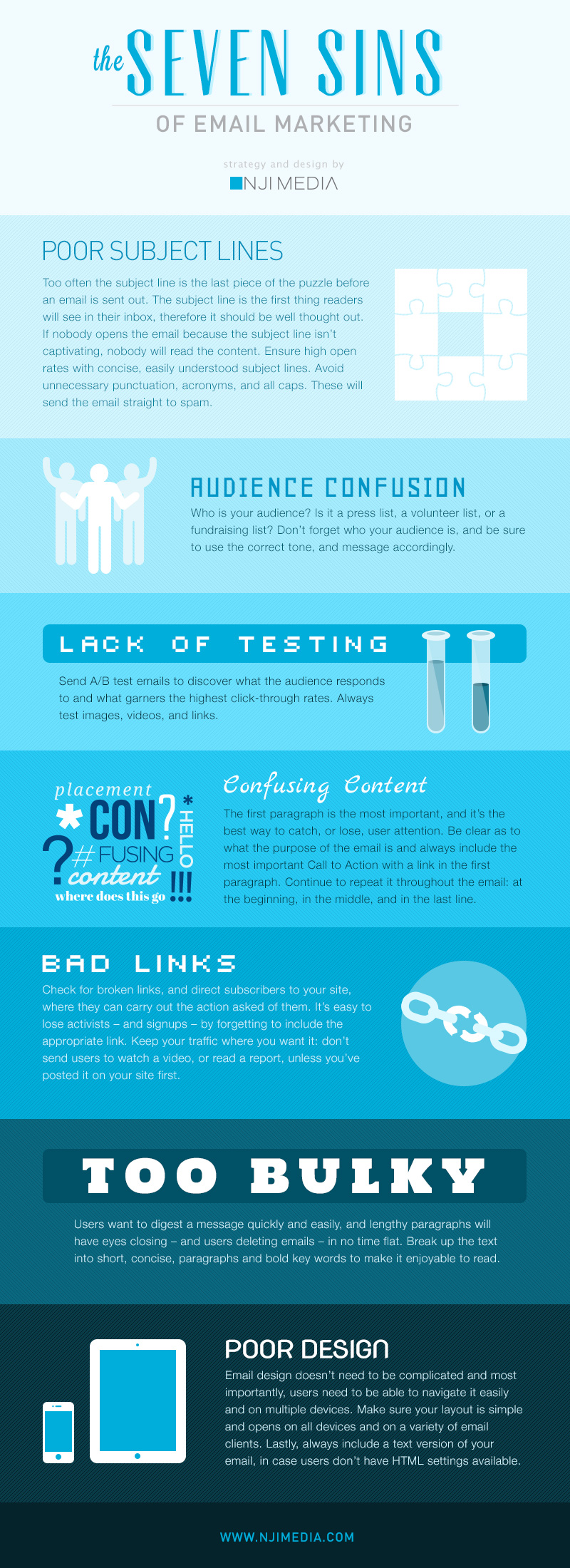
7 Sins and Top Email Marketing Mistakes - UPDATED

I've read a couple of pieces on this topic in the last few days, so here they are 


Mistake No. 1: Neglecting Buyer Needs

Mistake No. 2: Blasting the Same Message to All Contacts

Mistake No. 3: Failing to Adapt Messaging

Mistake No. 4: Not Linking to Your Website

Mistake No. 5: Ignoring Mobile Email Readers

Mistake No. 6: Not Having a Strategy in Place


Read more: http://www.marketingprofs.com/articles/2012/8624/six-email-marketing-mistakes-to-avoid#ixzz233W4DRS1


Not running the SPAM checker

Sending One Big Image

Forgetting the TEXT Version

Over-Zealous Design / CSS Styling

Not Testing Enough

Ignoring CAN-SPAM Compliance Requirements

Ignoring the Inbox Previewer

Deleting and Re-uploading Lists for Each Campaign

Using Poor Email Structure

Not Designing for Blocked Images *


*Read the detail at Top Email Marketing Mistakes | Business Email Marketing Blog - Pinpointe


Wednesday, 25 July 2012

Symbols in Subject Lines - Deliverability and Impact

Setting aside my personal view (Symbols in Email Subject Lines) that we should focus on the relevancy of message , rather than putting lipstick on a pig, I cam across 2 interesting views on symbols from Return Path and Alchemy Worx

A couple of key take outs -

''I have heard some marketers question whether adding symbols to subject lines will affect deliverability.  In the research I’ve done so far, I have not seen that to be the case, and all of the examples showcased above were delivered to the inbox versus the junk folder'' 


''It’s also important to note that these Unicode symbols will not work in every email client.  In addition, some of the symbols won’t render well on the small screen and will end up looking smushed and unrecognizable''
- Return Path


Image from Alchemy Worx

''Even if testing shows this to be effective at the moment, this advantage is likely to disappear over time as the trick becomes more prevalent.'


''Let’s not just do it for the sake of it, or because we want to cash in on the trend then move on''
Alchemy Worx


Read more at Return Path and Alchemy Worx

Saturday, 14 July 2012

A Word of Warning From 2009

“We’ve hinted before that agencies that can’t transition from pushing out messages to nurturing customer
connections aren’t long for this world."
– ”US Interactive Forecast”, Forrester Research, Inc., July 2009

This holds true now as well as then

For brands as well as well as agencies

Friday, 6 July 2012

Welcome to Channel 4.com

It's always nice to be made welcome

So when I recently confirmed my email address during signing up for C4.com, the confirmation link sent me here.


My only gripe


When asking me to confirm my email address to complete my registration, why does it take 2 hours for the email to come through?

I'm there ready and wanting to use the site, I'm engaged, it's the 5 minute window when you will get the highest open rates.

You need to send it to me now, not later. The Welcome emails set the tone for the future and to a certain extent dictate future delivery into the inbox, higher open rates.

I'm not going to re-invent the wheel so here are some great reasons from emailcritic.com to get the Welcome email in nice and early

  1. You’ll engage. 
  2. You’ll enjoy a higher open rate
  3. You start building that relationship
  4. You don’t have to do a thing
  5. You get a chance to upsell
  6. You build trust
  7. You show appreciation
  8. You set expectations…again
  9. You build brand
  10. You improve deliverability
  11. You gain a competitive edge
  12. You get to reward them

Wednesday, 4 July 2012

Encouraging the Conversation


Clay Shirky suggests that in many cases, writing a review is more like writing fan mail (or hate mail) for a product, and the people who post them do not really expect it to be read.


So why do people write reviews.( As far back as 2010 24 percent of adults have posted reviews or comments online about things they buy (Hubspot, Online Product Research, September 2010) This infographic from Demandforce highlights some interesting reasons why they do.

Demandforce Infographic

But for whatever reason, it's always nice to be told that the content you've taken the time to produce actually gets read. So, it brought a smile to my face seeing this appear in my inbox this week from TripAdvisor


Trip Advisor Email

The pub I reviewed was as far as I was concerned pretty much out in the middle of nowhere so I was a little surprised to see 29 people reading my review.
Millennials infographic
Talking to Strangers

But people do, as the aptly named infographic from Bazaarvoice highlights, like 'Talking to Strangers'. This is particularly important of the Millenial Generation - that is , those born around the turn of the Century- who in a few years time will have the real buying power.

Over 84% claim that content from strangers has an influence on what they buy

Where my generation will listen to friends and family, my daughter's generation will listen to strangers ( so much for here listening to parental advice!)

So sites such as Trip Advisor need to keep that flow of new reviews coming in, and there is no better way (other than perhaps monetary rewards, which perhaps reduces the integrity of the review) than by keeping the reviewer informed of how their content is being used.

But first of all, you need to ask for those reviews.


Here is an example of a very simple approach from Laterooms.com

Laterooms Review Prompt

Key here is the ' 100% Genuine Reviews'.


This is important because not only do Millenials listen to strangers, but they don't trust what brands say, as backed up by the Nielsen Global Trust in Advertising Survey

Nielsen Trust in Advertising

Also, an interesting option from Homebase where they have actually compiled a list of my purchases over a period of time...


But of course the bonus of this conversation encouragement is that it actually prompts the consumer to re-visit your site increasing engagement and obviously offering the opportunity cross and up sell

UGC Process


Tuesday, 3 July 2012

C4 Showing ( and Setting ) an Example

While looking up a chicken recipie on Channel4.com, as one does, I noticed that Channel 4 offer the opportunity to get updates

Although they don't explicitly say it is via email, I love the way they offer you the opportunity to see an example of what might be coming your way


Saturday, 30 June 2012

Never Say No to Panda

Ever subscribed to newsletters but then get bombarded with an onslaught of offers and seemingly non relevant communications?


Their strategy? Eventually you will capitulate, no matter how many times you say no.


Never say no to Panda..see the whole range here

Thursday, 28 June 2012

Habit Forming in Online Grocery Shopping

This email was brought to my attention by the Alchemy Worx Favourite email article, so I won't go into detail about the email itself but focus on the mechanism they have to create a shopping habit.


As you can see , Tesco are offering a saving of £20 on your groceries.

This is how it works though, you actually have to make 3 individual shops and spend £40 each time to get the money off. So essentially spend £120 and get £20 off.

Then logic behind this is quite simple. As we all know in online shopping , the second purchase is sometimes harder than the first - which may have been prompted by another offer..( see Ocado examples).

I'm guessing that for Tesco, getting the 3rd shop is also a key tipping point as you are now getting into the habit of shopping with them.


Below we see how Ocado focused on the second shop a couple of years ago
Another grocery retailer I worked with actually established that 5 was the magic number.

So Alchemy Worx were right to place the email in the Strategy Award.. but Tesco only get my vote if they have targeted the email at a segment of their base that need nudging from the odd shop or two , to much more of a habitual Tesco online shop.


It does seem to be going to existing customers, because of the personlization of the products, but I feel that perhaps the introductory copy could have been more explicit about how these customers have tried the service already


One very complicated way of doing this is highlighted by the way that Waitrose promoted their home shopping in their in-store publication Waitrose Weekend  .


I prefer the Waitrose mechanism as it rewards each individual shop with the reward increasing as the relationship grows, and it equates to a 20% discount in comparison to Tesco's 16%. You could argue that Waitrose have more margin to play with.

Maybe we'll see that mechanism appear at some point in email, although it would greatly simplify things for the customer if they only had to enter 1 code at the start of the series of shops and the e-commerce system just gave the ever increasing discount each time they shopped!

It's interesting to note the difference in the spend target each retailer is aiming for - a reflection of the average basket value for the majority of their customers and their cut off point for ensuring a profit on the service


Friday, 22 June 2012

Behavioural Marketing eCRM and Euro 2012

eCRM marketing programs based on behaviour will outperform those based on past purchase of declared data

That was one of the take outs from a webinar I attended this week, presented by Lyris and Forrester ( checkout #Lyriswebinar on Twitter)

For those of you that noticed by post that had nothing to do with eCRM this week, you may have noticed a slight allegiance to the Italian football team. I may even have purchased some Italian sports kit from Puma in the past

Well, during the last couple of weeks, I may have also spent some time browsing at the Italian products on the Puma website.


So ,despite the fact that 8 teams have qualified for the Euro 2012 Quarter Finals, it was good to see this subject line in my inbox


That was sure to get me to open ( although the key ring was superfluous, maybe it was a test)

And that was followed up with a nice piece of tailoring with the Italian team being the first image - They can be forgiven for not having the actual starting line up that won the game to confirm qualification


As I haven't bought anything from Puma for quite a while, I'm going to assume they have looked at my recent web behaviour, although they may very well have taken both into consideration before targeting this content at me.

Anyway, top marks for segmentation and timing..not sure about those dodgy key-rings though

Wednesday, 20 June 2012

Welcome


Where Do I Sign Up? talked about some best practice tips on making email registration easy, while Where Do I Sign Up? 2 highlighted some of the roads that can lead to registration. And my last post on signing up looked at some of the Thank You for Signing Up Pages

Now of course the next important stage here is to consider how you then Welcome the subscriber by email.
When you consider that the Welcome email is often the most opened email in the whole programme, its worth considering taking some time to make sure you are getting it right. After all, this is the point where the consumer has just given you permission to speak to them.

Rather than re-invent the wheel here, I'm going to point you in the direction of an excellent whitepaper from the Inbox Group that gives some great insight into the Power of the Welcome


Exploit the Power of the Welcome can be downloaded here

Sunday, 17 June 2012

Pointless QR code on Father's Day

I actually a QR code fan I even have them on the back of my business cards. But sometimes..just sometimes I wonder about the sanity of the marketers who use them


Of course Father's Day is upon is this weekend and being a grateful son, went out to buy a card the other day.

I chose the image below as my dad loves his garden, so it felt appropriate

IMAG0335.jpg


Now on the back of this, while checking out the price..sorry Dad..I noticed the QR code

IMAG0336.jpg

Scan me , watch me?

I tried.

Now of course, the card still being in the cellophane wrapper I couldn't get to scan it properly but I bought the card nevertheless.

I got home and tried the code again, and this redirected me here

I just thought..huh? What was the point of that?

I've just sent my dad a physical Fathers Day card. Mainly because he is of an age where he still appreciates a physical card ( funnily enough so does my 13 year old daughter). So what is the card with a QR code trying to do? Its not even as if the video is some how related to the image I had specifically chosen for my dad.

Are you trying to convince me to move over to e-cards?

Is it meant to make my father think, great son, he said Happy Fathers Day twice?

Can we think about technology before we run headlong into applying anything to everything?

Saturday, 16 June 2012

Favourite Subject Line of the Week


If only because it led to this


Now a few things spring to mind.

I cant quite figure out if this is great segmentation or not. Yes, I haven't shopped with Figleaves for a while now so, so as a reactivation piece it makes sense. But I've only ever bought male products from Figleaves so either they are teasing me a male with a shot of a woman in lingerie or they have ignored me as a male. ( In all fairness I'd rather see a woman in lingerie than a man in a pair of pants )

So I checked my last few emails, and yes they all had lingerie clad women - I wont put them all on here you'll have to take my word for it.

Maybe my personal details were wrong? So I checked them


No, it seems they don't bother segmenting male versus female.

A client of mine once suggested to me the reason they didn't segment male versus female in their fashion newsletters was that they didn't have enough male customers on the base. So I politely asked how many they had. A top of the head figure of 10% was mentioned, with a promise to go check.
After a little checking, a figure of 25% came up. Now considering that as part of their product offering, there was a specific male range it now became obvious that they should be doing something even if mean that part of the email had some male content. enough said, they took the advice and sales of the men's range increased

I was intrigued by the copy at the top right of the email suggesting that I've left something in my basket. 


Especially as it got me to click though to this.


Why would you do that? Again, you 2 possibilities. Either you are trying to trick me into going to the website or you are using some email template from another part of the email programme. Whichever it is, don't do it! It's confusing, wastes my time and actually reduces the chances of me clicking though in the future

Friday, 15 June 2012

Improving Data Capture with Social Sign-in


I was very pleased to be invited to the Silverpop Customer Summit, Amplify , this week in London


One of the topics raised was that 77% of people  said they would prefer Social Sign-in as opposed to other methods of registration. In fact that number is now as high as 85% in the UK according to research from Janrain

Other takes outs include that

  • 78% of consumers admit to having given incorrect profile info
  • 82% might leave a website if asked to register the traditional way
( Funnily enough Janrain doesn't offer Social Sign-in to register for the report)

This reminded me of the Google Checkout video that raised a few laughs last time I presented it at a conference last year

Enjoy!


Silverpop were actually the first in the industry to introduce this

Tuesday, 12 June 2012

Authenticity over Price


Ethos - before you can convince an audience, they have to accept you as credible and as a result will think you are telling the truth.


One of the three fundamentals in being able to persuade your audience according to Aristotle ( see An A to Z of eCRM A is for Ancient Greeks for the other 2)


My take from this is that as a brand, we need to ensure that we don’t pretend to be something that we’re not.
Trust is the cornerstone of eCRM. Once abused it is rarely given again


I think is demonstrated very well in this website test where only 1 image has been changed on the site. Can you spot it?
Trust and credibility were bolstered with the Authorized dealer badge in black and blue.
This resulted in 107% jump in conversions!

Full case study can be seen at the the Visual Website Optimizer site

Monday, 11 June 2012

What we learned selecting an ESP Partner: Work Backwards


A few weeks ago I wrote a post that talked about some of the areas you needed to consider when starting off on that journey of selection of  a new ESP.


Having gone through that process I thought it might be useful to share some of the issues that cropped up during the new ESP selection process.
(All links go to Email Vendor Selection where this piece was originally posted)

Do your ESP research to save time later

When you start to consider your new ESP Partner the choice is pretty wide, so deciding up front what you need is very useful. In particular as this helps in deciding on how many ESPs you want to send an invitation to for a response to your requirements.

Your time is precious, so work backwards.

How many ESPs do you want?
OK this may seem like a strange question to ask but working for a marketing agency might well result in you actually working with multiple ESPs.. after all your client might be wedded to one that you have work with, alongside the one you choose for your other clients as your preferred ESP. But let’s assume you are choosing one
So how many Email service providers do you want to come in and actually present to you,  demo the email system to you, work with you to look more closely at costs and data integration – don’t forget that you are pulling on your internal resources  of operations, finance, IT, client services etc. I would suggest that you limit this to 3 if you are confident. If you are new to this you might actually want 5 vendors to come in and present to give you a better understanding of what’s out there.
So let’s assume that everyone wants your business ( and if you have done your research in deciding what your future ESP partner should look like, they all will), that probably means sending out the invitation to 5 or 7 possibles.

Focus while selecting an ESP Partner

In 2 ways.
1 – Use a matrix to evaluate the responses based on the requirements you pulled together during the research phase. This helps at all the stages when selecting for the next stage of the process and allows a fair assessment from all internal parties. Don’t forget that elements of the criteria will be important than others to weight them accordingly
2 – Have a timetable and stick to it. ESP submissions should be back at a certain time, presentations within a short space of time, marking to be completed immediately. It’s easy to lose momentum especially when there are lots of people  and departments involved.

Show me the money

It’s not just about the money of course (well except for the CFO) but it an important factor. But rather than think about just the CPM, think about Total Cost of Ownership in years 1, 2,,3.
There are lots of costs to be considered including CPM, Internal Resource Costs for any migration, set up costs, monthly fees, extra costs for product elements that come standard with one system but not with another, support fees..the list  goes on.
One way of making sure you are comparing apples with apples, is to at some stage to get the ESPs to submit costs in a standard way that matches your requirements, not theirs!

Learn Along the Way

Each time you speak to an ESP you will learn something new so don’t be afraid to alter your requirements along the way, and go back to the other ESPs for clarification.
But also dig into what the ESP will give you ( free of charge of course) in terms of learning more about how to use the platform they are selling to actually meet your business objectives.

People Count

Are you just buying a tool ? Think again. The tool, platform is important but so are the people who will be working with you so make sure that you keep that front of mind as well as somewhere on your score matrix
So ..Go Beyond the Salesman
Meet who will be supporting you technically and from the client services team. Will you get on with them even if you hate the sales guy?
As I ended my last post I am not advocating that you stick with one ESP for life, but you might as well be prepared for it..just in case, and like the people you’re with.

Saturday, 9 June 2012

Creating Personal Experiences


As we are all individuals it is understandable that our reactions to any interaction with a brand is dependent on how well they have understood our wants and needs.


This was brought to the fore recently with me when I accompanied my fiancée to the florist to discuss the flowers for our up coming wedding*. Obviously an important day which is highly personal and has to be right first time..as hopefully it will be the only time.

The florist started off by asking key questions around the location of the ceremony and Wedding Breakfast and of course when the happy day was going to take place. In marketing terms she was establishing important elements in the area of Environment and Season, so beginning to create a picture of the context in which the flower arrangements needed to be suitable for.
She gently prompted my fiancée (not me) as to what her favourite flowers were and how many people would need special flowers such as bridesmaids, flower girls, mothers, fathers, groom and ushers. Again there was an understanding of the decision maker in that area.

There was also a gentle discussion around budgets. At which point the focus slightly moved towards me - am pretty sure it was only out of politeness really as I don't think I had much influence

Now of course I sat there taking a genuine interest in the discussion and perhaps taking slight offence when my suggestion that the flowers should be white yellow and blue to signify my allegiance to my football team.
And then it dawned on me how the process reminded me to some degree of how we create email communications for our clients customers.

The 3 core elements of any message from a brand include
1                 what we know about the customer
2                 some understanding of the context into which the communication will arrive – so areas around environmental factors and seasonality
3                 a reflection of the commercial priorities for the brand

And as I write these I realise that I have actually written them in the order of importance – just by chance

At the heart of the email experience is the customer and context. Of course we don’t usually have the luxury of being able to sit down with the customer and ask them what they want and when but in the digital world we can use the customers digital  body language to get closer to that understanding.

In our world we can use a mix of behavioural, transactional and profile information ( customer preference centre, opens, clicks, link analysis, web behaviour, social behaviour etc) to get that picture of what the customer wants and might want at that moment in time


And context is increasingly important these days. Context is a complicated mix of

where in the lifecycle the customer is
 how close to an individual purchase they are
 where they are physically
on what device they may be reading the email

All of this information is available either explicitly or implicitly through behavioural profiling

It's not always easy, but the rewards can be bountiful

(* Actually this piece was written before I got married and left in draft somewhere for 6 months.)


Friday, 8 June 2012

I'm Shaped Like an Egg

You've gone missing email subject lines are a favourite of mine.


So I was intrigued by this one from Ocado


And the resultant email looked like this

 So it's a nice little incentive to get me back, but a couple of areas intrigued me.

1 - I wondered why reasons to come back #2 and #9 were chosen ..and do they differ for other people? A test perhaps?


I ask because a few weeks ago I got this one


The other reasons included


Based on my previous purchase history with Ocado I would have plumped for #2 and #6 so they seem to have #2 nailed with me

Did anyone else get other reasons ?

There is a big change in focus from Ocado . They now play much more on the

  • potential relationship between the brand and me
  • reasons to look at the brand again

Of course mixed in with the tempting offer. This has changed from propositions that were much more offer based previously as you can see from these subject lines


2 - I saw the 'Rate this email' link...so I clicked of course, but I wondered how many did given its lack of prominence


Which I thought was a great way of getting some feedback on the email itself. I've often talked about getting feedback on your email programme with clients- nice to see someone actually doing it. Shame i'ts not one of mine.

One slight amend I would make is perhaps a similar 'Rate this email' link at the end of the email as well.

Offer Based Reactivation

Ocado are very keen on reactivation programmes based on a discount off your shopping basket. Usually £15 off a £75 based shop ( in this instance it was a £20 off £80). Of course this time they have mixed this with a 'reasons to come back' message. The 'offers' message is also typical for the UK online grocers, especially for first time shoppers, as this voucher printed for me last time I shopped in my local Sainsburys supermarket shows


Another approach is one that Ocado tried a while back focusing on that all important 2nd shop.


With online grocery shopping the important shops are

First Shop - Can we get you to trial the service?
Second Shop - Great, the first shop went well so can we now start to show you how easy it is to repeat that first shop
Fifth Shop - If the retailer can get you here then unless the retailer really messes up, you're hooked!

The theory is, that by the further we get the customers down the road to habitually shopping with us, the less likely we are to need the Reactivation email.

Don't get me wrong, I'm not advocating abandoning them, but we need to work harder in keeping those hard won customers in the first place.

Many reactivation wins are actually just getting 'habitual' offer seekers back for one more shop before the next reactivation email. Your business model might be quite happy for you to this. If you can reactivate enough people in that reactivation campaign to cover the costs of the campaign. And of course, its not just reactivating one time only, but hopefully getting the customers shopping regularly.

Acquisition by another name


Of course reactivation is to a certain extent another form of Acquisition - hence the similarity between the Sainsburys and the Ocado offers above.

And sometimes, email won't do the trick. It might be a case that you have to look at your data and get some insight into how you originally acquired this segment that needs re-acquiring. Through what channel and with what kind of offer did you originally acquire them?

Customers are strange creatures. You can't assume that the customers acquisition channel of preference is their preferred channel for on going communications. I worked with one retailer where email just wasn't cutting the mustard so we reverted to direct mail to re-acquire customers who we deemed valuable enough. Again, the business model plays a strong argument in determining what we do with customers

Don't put all your eggs in one basket


2 things to take from all this ( probably more but I'll keep it at 2)

1 - With reactivation mailings you need to try different approaches. In some cases a simple offer led approach may well work, but are you actually just training or feeding a certain segment into some kind of offer seeking behaviour? The use of offer and reasons to come back is a good approach, but would they be better off using single propositions for discrete audiences?

eg   Single Purchased but Lapsed    - Offer Proposition
       Previously Regular but Lapsed - Reasons to Come Back Proposition

(of course the matrix could be much bigger than this )

2- Reactivation campaigns don't just sit there in isolation. They form part of a bigger email marketing plan that forms part of an overall marketing and business plan. I've worked with clients who have kept much of their activity separate from each other and have never fully understood the impact of one on the other, or indeed on how they are contributing to the bigger picture. As a result they don't get the best out of the overall programme of activities, as they are too busy focusing on individual elements and not on how they work best together

Don't let there be a planning shaped role missing from your programmes


Wednesday, 6 June 2012

Press Pause

So I don't want to unsubscribe from your communications, but I don't want them for a while. 


"With the average rate of annual list churn hovering around 20-30 percent or more for most companies, marketers must make every effort to retain as many subscribers as possible, and one way to do this is to present them with options when they click unsubscribe," according to Loren McDonald, vice president of industry relations for Silverpop. 


Anyway,when I got an email from What Car? ( which I'll be honest, I don't even remember signing up for) my first thought was to unsubscribe, or at least see what options I got given.


Well I got this page shown to me. Of course the normal way of unsubscribing is there of course, but also the opportunity to pause from the What Car? emails for 30 days. Which is a great start ( I think there is a massive opportunity to do this in many sectors for example travel, after all, I don't book holidays every week).


But why 30 days?

That just looks like its the auto setting for the email platform. A more elegant solution would be to offer different periods based on the sector. So, in the instance of What Car?, I may not be looking at buying a car for 6 months or so. Maybe I might want to start my research again in 3, so offer me 90 days?


Of course it's a a brave move by brands to offer NOT to send emails out for a while, but it can obviously pay dividends. As in the case of WhatCar?, they will  know the email subsriber is more likely to be closer to buying hence providing some information for any Marketing Automation or Lead Scoring programme in the background.


And it's certainly being more customer centric